Tesla's Technology Miniaturized And Simplified For The Masses
Published: Sun, 11/02/14
Spokane, Washington - November 2, 2014
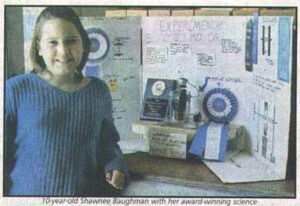
Fifteen years ago, Shawnee Baughman of Coeur d'Alene, Idaho was competing for an elementary school science project and an electronics wizard happened to work in the same building as her father. She was provided with a simple schematic and a bit of coaching. With that, she went off on her own to build a little motor that spun a wheel, lit an LED light, and ran from the same 9 volt battery for the entire five days of the science fair.

Many experts claim this is impossible, but actually there are many systems that produce more work than we're required to supply, because the excess energy is provided by the environment. A good example of this is the refrigerator. This ordinary kitchen appliance typically operates with a "coefficient of performance" of 2.0, which means that twice as much heat is removed from inside than the equivalent electricity used to do it. Most scientist believe that this kind of performance is only possible with heat systems, but John Bedini and others have demonstrated these principles with electromagnetics as well.
Their first book outlining the basics of this technology is Bedini SG - The Complete Beginner's Handbook, which includes all of Bedini's own personal specifications for building his machines, as well as an in depth explanation of the science and theory behind its operation. With this book, just about anyone can build a working model.
The second book is Bedini SG - The Complete Intermediate Handbook. It digs deeper into the theory of the technology and shows how John's circuits act like miniaturizations of systems developed by Nikola Tesla over 120 years ago. What this process does is take the high voltage spikes from an electromagnetic oscillator and charge a capacitor with them. This capacitor is then discharged into a load, such as a lead acid battery.
Engineers are normally taught to ground these spikes out so they don't damage other electronics on an electrical line. In fact, that is what a "surge protector" is designed to do. Through experimentation, John discovered that these electrical transients have a number of unusual characteristics. One of these benefits includes the ability to charge batteries extremely efficiently, and even revive some batteries that are considered dead.
Although many engineers claim these spikes can't charge a battery because they are just high voltage with virtually no current, there are thousands upon thousands of global experiments being conducted with these circuits that prove otherwise. And if these spikes are used to charge a capacitor and then that capacitor is discharged into a battery, even more amazing results can be had. And this is one of the methods for using electricity that Nikola Tesla developed back in 1893. John's circuits are literally a miniaturized version of some of Tesla's greatest discoveries.
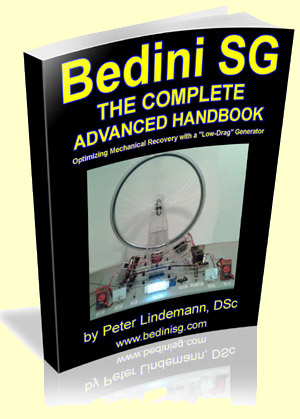
This third book also reveals many details from John Bedini's other related technologies, some of which have never been released or explained to the public before. In that sense, it also doubles as a tribute to his tireless contribution to the field of advanced energy research over the last four decades.
Learn more about this amazing trilogy at http://www.emediapress.com/go.php?offer=epdollard&pid=40